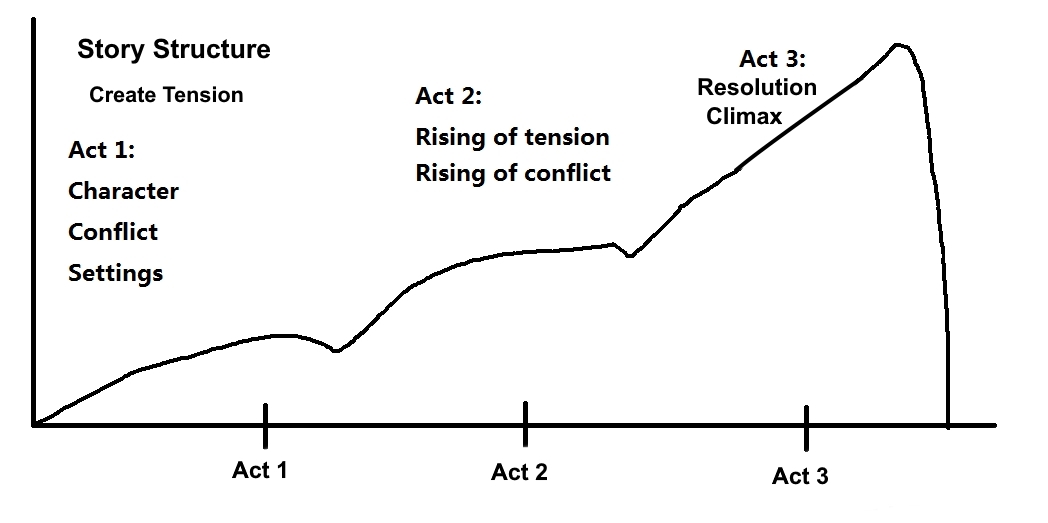
Think of Structure as a Series of Road Signs Posted Along Your Journey
Think of structure as the rails that keep you from straying onto the meandering path that can so often lure a writer from the correct course of the story.
Structure creates the underpinning of the book. Without it, narratives have no form, and the plot has no provocative way to move the reader from one moment to the next or from one scene to the next.
The most basic element of structure is what we were all taught in school: beginning, middle, and end. If there is a fixed star in the universe of storytelling, this is it. Every story has a beginning, middle, and end. Every scene has a beginning, middle, and end. But how these elements are dramatized- how they are conceived and shaped, juxtaposed and presented to a reader- is up to you.
Structure
Think of structure as a hanger. It holds and shapes an infinite variety of shirts, blouses, dresses, coats, and suits. One of the most important structures you will learn about is the Symmetrical Storybook Paradigm. This is the structure which underlies most of the best-loved storybooks.
You will see that no matter how carefully you labor over the tone, word choices, plot, character, setting, theme and style of your book, you must have a thorough grasp of its structure if you wish your book to succeed.
Indeed, you will find that an expert command of structure is the key to writing a successful novel.
Like an architect who draws a blueprint before building, an author should plan his story before sitting down to write.
What is so important about the Symmetrical Paradigm and its variations is that they can apply to almost any plot and any sequence of events in a story.
It doesn’t matter whether the story is a suspense novel, fantasy, fairytale, folktale, or any other tale, for that matter.
It doesn’t matter whether the conflict that occurs is person-against-self, person-against-nature, or person-against-person.
It doesn’t matter whether the story is told in the first person or third person.
The Symmetrical Paradigm can apply to most story books.
The Three-Act structure


The Three-act Structure means having a beginning, middle, and end
The opening is the first act. The characters and problems are introduced, along with an inciting incident, or turning point, that moves the reader from Act 1 to Act 2.
In Act 2, the main character takes action, and more action and even more action to solve his problem. The act most often culminates in a low moment when all feels lost.
Act 3, contains the resolution of the problem, or the ending. Once the problem set out in the beginning of the picture book is solved, the story is over, except for tying up any loose ends.
Form and Structure
Is the opening strong and compelling? Has the setup and description gone on too long?
Does the plot build to a pivotal point? Does the ending grow out of the story? Does it evoke an emotional response and make the reader want to read it again? Are there strong page turners?
Your story must focus on your main character. The reader wants to follow the main character’s dreams without regret for what others think. Have them stand up for their convictions in spite of other opinions.
Basic Dramatic Structure
According to A Handbook to Literature by William Flint Thrall and Addison Hibbard, operatic structure is divided into distinct, identifiable parts.
- The rising action
- Exciting force
- Conflict and complications
- Climax
- Falling action
- The reversal
- The resolution
- The last moment of suspense
Whether the classic Greek dramatist was dealing with comedy or tragedy, this critical story elements did not change. Twenty-five years later, the structure is still useful.
Keep in mind that the middle of your story moves through the conflict and complications, the climax, and the reversal and resolution.
Suppose those exciting forces booster rockets were powerful enough to propel you through the Earth’s atmosphere and into outer space. You’re on the way to a quiet vacation on the moon, and you’re now entering the middle of the journey, the longest and most dangerous part of your fictional Odyssey.
Lots of things can go wrong here – battery dies, directional signals get screwed up, spacesuits leak – is your job to keep all the parts tuned in working order so you can overcome the obstacles you confront, complete your mission and reach your destination.
Eight Approaches to Structuring Your Story
- Keep it simple.
- Play it as it lays: make a few notes about your characters and scenes. Here you are winging it, allowing one situation to lead to the next that leads to the next. There’s not much advanced planning, but there is room for spontaneity.
- Take baby steps. If dealing with the challenges of plot, don’t you break your story into manageable segments to remove the intimidation from the task. Establish the primary story elements of beginning, middle, and end. Then envision your narrative as an ongoing, interconnected chain of scenes and sequel. One actually causes a reaction that causes another action and reaction.
- What is the logical sequel to the scene?
- What action does the scene trigger that leads to the next scene?
- However, I planted the hook to pull the reader into the next scene?
- What is my hero doing to move the story along?
- What is the next logical step in the story?
- How does the scene contribute to the larger context of the story?
- Create a literate outline. Before you write your book, break down each chapter into a white ball, noting which character situations are involved in each chapter the outline will provide a map to follow and give you an overview of the book. Remember, however, that some of the most interesting journeys involve detours and unexpected sights. Even as you follow the map, stay open to the possibility of surprises.
- Walk the North forty. Develop a detailed chapter by chapter breakdown of your book, creating a visual map to follow. Once you get a grasp on the overview, you can get a better picture of what is happening in your story. When you see places where you dropped the plot stitch or where one character hasn’t appeared in a while, you can pick up the thread before you move on.
- Decorate your wall. Make scene by scene notes 3” x 5” cards and arrange them on a bulletin board. The advantage of this method is that you can move your cards around, add some and toss others, without messing up your overall story. Color coding characters and plot theme are helpful when you use these methods because you can see what character or theme or plot point is missing.
- Go classical. One of the old ways of following classical story structures of Greek drama from the exciting force of the climax to the resolution.
- Mix-and-match. Do your own thing. Consider all the different ways to structure your story and choose the method you prefer. If you want to make scenes and sequel with a literary map, do it. Find the combination that’s right for you.
Holding the Readers Interest
For a story to succeed, the reader must be engrossed in each successive moment of the story and must care about what happens next or at least be curious enough to want to know. When the reader is absorbed in every step, the next step is fresh, and a fresh experience. One of the tests of a good story is its ability to hold the reader in the present and every moment of his unfolding. How can this be achieved? A simplest form, it is the reader wanting to discover what is unknown, to see the entire picture, or the complete action, after having seen its beginning. But you can’t count on the unknown alone to impel someone to keep reading. The reader must also care enough about the beginning to want to know the rest of the story.
One way to hold the readers’ interest is by introducing uncertainty or suspense. The nature of each picture or sequence in the unfolding of an action can contribute to suspense.
When an actor drives at night on a road with unexpected turns, the stretch of road he can see at one time becomes shorter. The actor has to watch the road very carefully, and our suspense increases. The sequence is no longer predictable. We become concerned about the actors’ safety and wonder what will happen next. On his way home, he has to drive up a winding mountain road. The sky darkens. Heavy rain falls. After a treacherous trip, he finally arrived home safe, where he could read his favorite novel.
The logic of cause-and-effect explains how and why one event follows another.
But in other kinds of stories, not conforming to our life experience, fantasies, for example – we need the rigorous logic of cause and effect to accept that credibility. Otherwise, they may seem accidental or improbable, and we won’t care about them.
Story Structure Chain of Events…
Fun & Games (20% – 50%) Page 80-200. The protagonist goes on a roller coaster ride and wins and losses. They try to get what they want, they fail, and they pivot and try again. Based on a 400-page novel.
Midpoint (50%) Page 200. My main character named Vanessa either has a false victory, or a false defeat. This scene raises the stakes as you head towards the climax.
Bad guy close in (50%-75%) Page 200-300. Things start to fall apart for the protagonist.
All is lost (75%) Page 300. The protagonist is brought to her lowest point.
Dark night of the sole. (75%-80%) Page 300-320. This is the deep soul-searching of the protagonist to find the solution to the problem facing them. The protagonist starts to realize what they need, versus what they want.
Break into Act 111 (80%) Page 320. The protagonist decides on the right course of action to reach their new goal.
Finale (80%-99%) Page 320-396. The climax, where the protagonist takes the course of action and ultimately succeeds or fails in their quest.
Final Image (99%-100%) Page 396-400. The plot outcome, this should be the opposite of the Opening Image, showing how much the protagonist has transformed.